
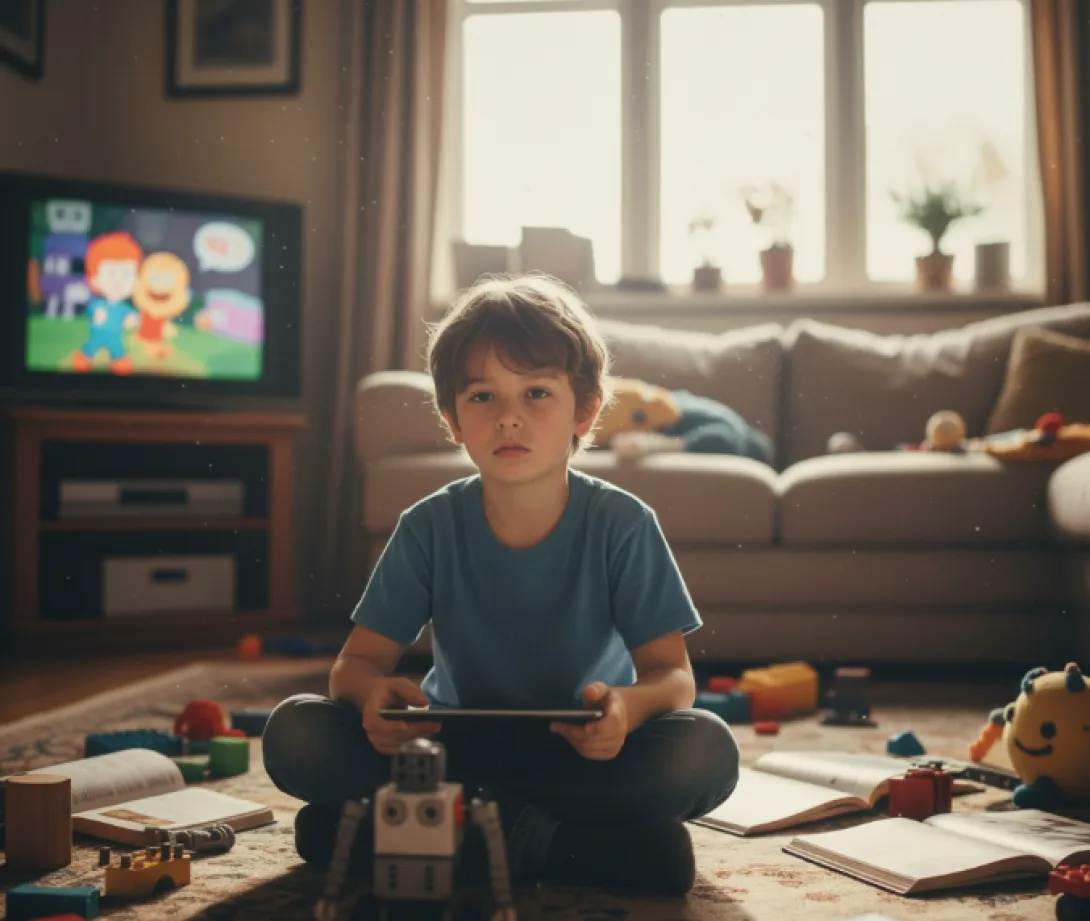
Attention-Deficit/Hyperactivity Disorder (ADHD) is characterized by difficulties with attention, and impulse control. Many children with ADHD struggle with intense boredom during monotonous or unstimulating situations. Boredom is not mere laziness or apathy – it is a restless state of wanting to engage but not finding the available options satisfying. The boredom involves specific brain networks and psychological processes.
Boredom in ADHD vs. Neurotypical Children
In everyday life, tasks that neurotypical children tolerate may feel “unbearably” dull to a child with ADHD. ADHD youth commonly complain of feeling bored and have a lower threshold for monotony or waiting than their peers.
In boredom-inducing situations (like long lectures or waiting rooms), children with ADHD are more likely to fidget, get distracted, or act impulsively as an attempt to alleviate their understimulation.
One survey found boredom was among the top daily challenges reported by teens and young adults with ADHD. This tendency can lead ADHD children to seek stimulation in disruptive ways if not managed.
When ADHD children make more attention errors on a task, they report greater boredom, suggesting a cycle where lapses in attention and boredom feed each other.
Dopamine and Brain Networks
Dopamine and Reward Pathways
Dopamine is a neurotransmitter critical for motivation and reward. Many children with ADHD have chronically lower dopamine activity in key brain circuits, which means they often don’t feel rewarded or stimulated by mundane activities.
This dopaminergic under-stimulation contributes to reduced motivation and quicker boredom – the ADHD brain “craves” more input to reach a normal level of engagement.
A child with ADHD may find it extremely hard to wait quietly for a larger payoff later – their brain simply doesn’t reward that patience, so waiting becomes aversive and boring.
Neuroimaging confirms that when forced to endure delays, ADHD patients show heightened activation in emotion-related brain regions (like the amygdala), indicating that waiting triggers negative feelings for them.
They may then react with distraction or hyperactivity “to decrease the perception of waiting” and to combat the boredom and discomfort of delay.
Default Mode Network (DMN) Dysregulation
Typically, when someone needs to focus on a task, the brain suppresses the DMN to prevent off-task daydreaming. Children with ADHD, however, show abnormal DMN activity – studies find their DMN does not attenuate effectively during goal-directed tasks or waiting periods.
In other words, the ADHD brain slips into default-mode (internal thoughts, mind-wandering) too easily, even when the child should be concentrating.
If the external task doesn’t capture their interest, the brain’s “autopilot” network takes over, and the child feels bored or drifts off. The result is that ADHD kids are neurologically primed to daydream and disengage when under-stimulated, intensifying feelings of boredom.
Executive Function and Arousal
ADHD is also associated with sluggish engagement of the brain’s executive control networks (primarily in the prefrontal cortex) which help sustain attention and regulate effort.
The combination of low cortical arousal and impaired sustained attention makes it harder for children to tolerate low-stimulation activities. As a consequence, their subjective sense of time may stretch (time “drags on”), and boredom sets in quickly.
In brain imaging terms, ADHD children often display overall lower cortical activity and less reactivity to stimulation than peers. This hypo-arousal means they start from an “under-engaged” state, requiring more intense or novel input to reach an optimal alertness level. If that stimulation isn’t present, their brain easily flips into boredom or seeks stimulation elsewhere.

Why children with ADHD are especially boredom-prone
Optimal Stimulation/Arousal Theory
Initially formulated by Zentall (1983), this theory posits that hyperactive and impulsive behaviors in ADHD are self-regulation strategies to counteract chronic under-arousal.
The ADHD brain runs “underpowered” in low-stim environments, so the child is driven to create their own stimulation – by fidgeting, moving, seeking excitement – to reach a more comfortable level of arousal. This is why an ADHD child might drum on the desk or daydream in a quiet classroom. Such behaviors serve to maintain an optimal level of brain arousal and alertness.
Researchers describe boredom as a “hunger for information” or novelty, which pushes individuals (especially those under-aroused) to seek something more engaging. ADHD kids, being hypo-aroused, experience this hunger frequently and intensely.
Delay Aversion and Motivation Deficits
Sonuga-Barke’s dual pathway model of ADHD includes a delay aversion pathway: children with ADHD are thought to find waiting or working without immediate rewards especially aversive.
They develop an intolerance for delay – boredom is the emotional signal of that delay (“nothing rewarding is happening right now!”). To escape this aversive boredom, they might opt for immediate but lesser rewards or abandon tasks that don’t gratify quickly.
ADHD students often prefer immediate stimulation (even if trivial or counterproductive) over sustained effort on a dull task that might pay off later. The lack of dopamine-mediated motivation for delayed outcomes leaves them overly reliant on whether an activity is inherently interesting in the moment. If it’s not, their boredom skyrockets.
This can also tie into intrinsic motivation deficits – many kids with ADHD have an “interest-based” attention system, meaning they can focus well on things that personally interest them, but struggle mightily with tasks that are routine or externally imposed. Without interest or novelty to hook them, their motivation fizzles and boredom takes over.
Attention/Executive Dysfunction
In ADHD, inattention, hyperactivity, and executive dysfunction are impaired – the child can’t consistently control their focus, inhibit impulses, or generate plans to engage themselves. Boredom has thus been called “a type of attention failure”.
If a child cannot attend to a less stimulating task, their mind wanders and the task becomes subjectively boring.
Likewise, poor executive function means they have trouble devising ways to make an activity more interesting or sticking with a goal despite boredom.
ADHD amplifies boredom because the usual mental strategies that help neurotypical individuals tolerate boring situations (sustained focus, self-distracting with daydreams at appropriate times, reminding oneself of future rewards, etc.) don’t function as well. The result is a lower boredom threshold and fewer tools to cope with it.
“Information Processing” Model of Boredom
Emerging research in cognitive neuroscience suggests that boredom occurs when there’s a mismatch between the information in the environment and the individual’s capacity or need to process it. If too little information is available or if one cannot effectively decode the available stimuli, the mind feels under-engaged and boredom ensues.
A 2025 study formalizing this idea found that people (including children) with ADHD have reduced information transmission – they extract less salient information from a given stimulus – and this lower cognitive intake predicts higher boredom.
In ADHD, internal traits (like weaker attentional focus or working memory) likely limit how much meaningful content the child can pull from a dull text or a slow-paced lesson. The environment might contain “enough” information for a typical child to stay engaged, but the child with ADHD, due to their decoding difficulties, experiences a sort of information starvation. Consequently, boredom is “heightened in ADHD” as a situational consequence of reduced information decoding.
Managing Boredom in ADHD
Excessive boredom leads to problem behaviors and frustration for children with ADHD.
Stimulant Medications
Treatments like methylphenidate (Ritalin) and amphetamines are known to boost dopamine levels and improve core ADHD symptoms. They also appear to alleviate excessive boredom. In a clinical trial, children assessed before and after 3 months on methylphenidate showed significant reductions in both ADHD symptom severity and boredom proneness. When the medication was withdrawn, their boredom and ADHD ratings crept back toward pretreatment levels.
Stimulants raise the child’s threshold for boredom. In practical terms, a properly medicated ADHD child may find it easier to stay with an uninteresting task without feeling as irritable or understimulated.
Structured and Engaging Environments
Maintaining a structured daily routine with planned activities may preserve the positive effects of treatment and prevent spikes in boredom that might lead to “risky sensation-seeking behaviors” or excessive screen use.
Consistency and rules from parents and teachers give ADHD children an external scaffold to keep them occupied and on-task.
For example, breaking homework time into short, timed segments with brief breaks can inject a sense of urgency and variation.
Physical activity is another form of structured engagement – regular exercise or movement breaks can help an under-aroused ADHD brain reset and may improve the child’s ability to focus afterward. Research has shown that acute physical exercise can modestly improve attention and reduce subjective feelings of inattention in ADHD, which likely makes boring tasks feel more manageable.
Even simple classroom strategies like letting the child hand out papers or do a quick stretching routine between lessons can provide the needed stimulation. Overall, keeping an ADHD child’s body and mind appropriately busy (but not overwhelmed) is crucial to ward off boredom.
Increase Stimulation During Mundane Tasks
When tasks are inherently dull, adding stimulation can help the ADHD child stay engaged. This can be as straightforward as turning the task into a game or adding multi-sensory elements.
If a child is bored by math drills, one might use colorful manipulatives or incorporate a point system with immediate rewards to make it more stimulating. Even something like background music or a “fidget” object to squeeze can provide an extra channel of input.
One experiment noted that providing environmental stimulation during waiting dramatically reduced ADHD children’s restlessness and inattention, implying that the boredom of an unstimulating wait – not the waiting itself – was the real culprit.
Teachers and parents can apply this insight by giving the child something to focus on during potentially boring downtime (e.g. a puzzle or an audiobook on a long car ride, a doodling notepad when stuck in a waiting room). Rather than expecting the child to simply endure boredom, proactively fill the boredom gap with engaging alternatives.
Skill Building: Boredom Coping and Mindfulness
Because boredom is sometimes unavoidable, it helps for ADHD children to learn coping strategies to tolerate and channel it appropriately.
Cognitive-behavioral approaches can teach the child to reframe the feeling of boredom – for example, reminding themselves that “boredom is a signal I might need to switch strategies” or that it’s just a temporary feeling.
One tip from ADHD experts is to have the child plan for boring times by keeping a list of fun mini-activities they can do when they start to feel bored. This might include drawing, building something, or imaginative play – anything constructive that can be turned to instead of disruptive behavior.
Teaching mindfulness techniques has also shown promise. Mindfulness training helps kids practice accepting the present moment and observing their feelings without acting on every impulse. For an ADHD child, mindfulness can increase tolerance for that itch of boredom and reduce the knee-jerk need to seek instant stimulation. Early evidence and clinical recommendations suggest that mindfulness and meditation exercises can improve attention control in ADHD and may consequently help manage boredom proneness. Even simple breathing exercises or short meditation apps geared for kids can start building this skill. Over time, the child might learn to notice “I’m feeling bored and restless” and respond by, say, taking five deep breaths or doing a quick stretch – a small pause that could prevent negative behaviors.
Leverage Interests and Novelty
Parents and educators are encouraged to incorporate a child’s personal interests into learning activities or chores whenever possible. If a student with ADHD loves dinosaurs, a wise teacher might use dinosaur-themed word problems in math or allow him to read books about dinosaurs during free reading – capitalizing on intrinsic interest to sustain attention.
Controlled novelty can also help: alternating routine practice with new, creative tasks keeps the ADHD brain on its toes.
However, novelty should be balanced – too much stimulation can be overwhelming, so the goal is an optimal variety. Some researchers liken it to providing the right “diet” of mental stimulation for the ADHD brain, to keep it satisfied and focused.
Combining medical treatment (when appropriate) with behavioral techniques and environmental supports offers the best outcome. For example, a child on ADHD medication who also has a structured, engaging schedule and has learned a few boredom-coping skills will be far less likely to spiral into frustration during a dull activity than a child without those supports.
High boredom proneness in ADHD has been linked to mood issues (like anxiety or depression) and excessive screen time or internet addiction in teens.
By helping children manage boredom in healthier ways, we not only improve their daily functioning but also potentially buffer against these longer-term risks.
Comments